
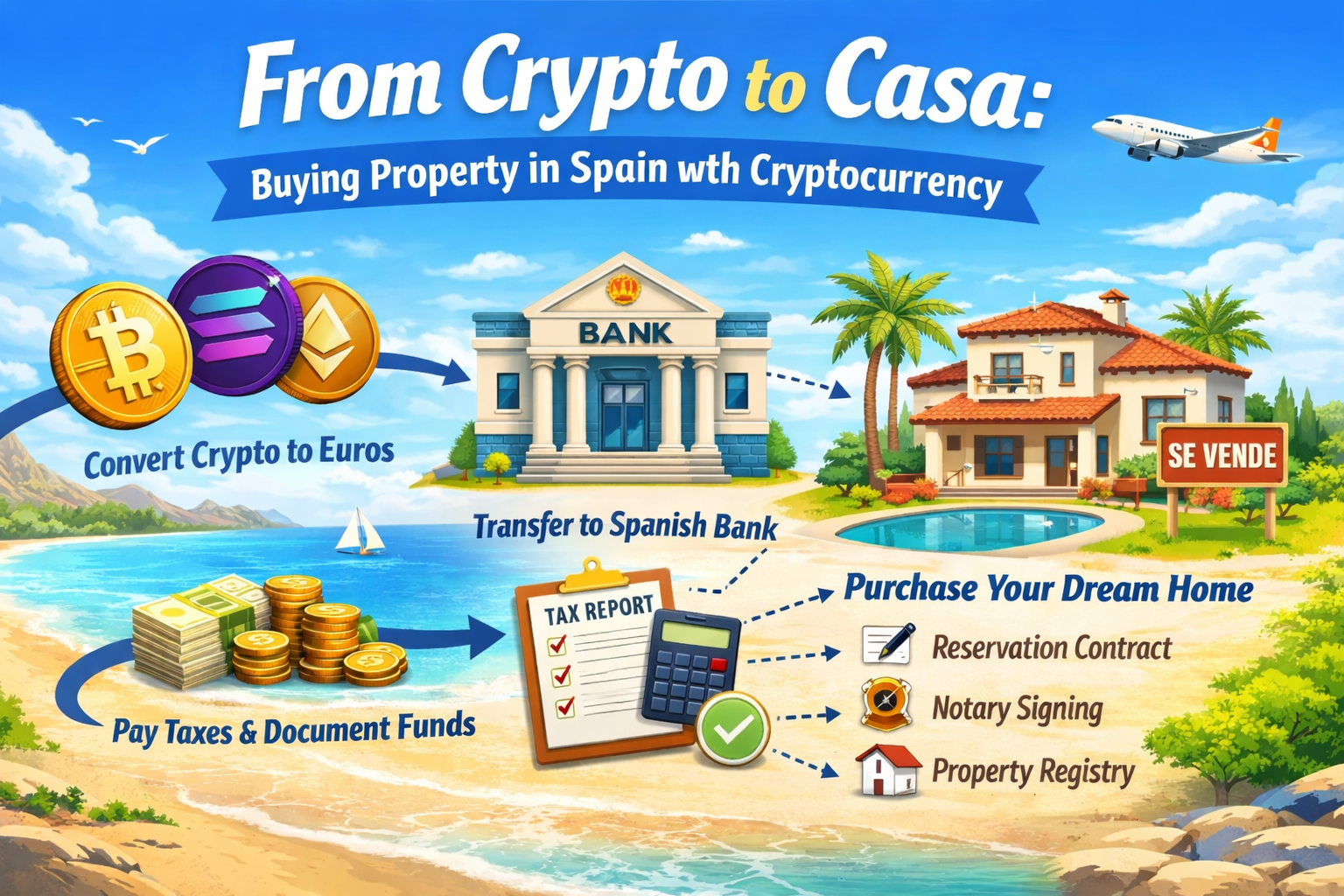
Cryptocurrency has created unprecedented wealth for investors worldwide, and many are now asking: “Can I turn my digital profits into a Spanish home?” The answer is yes—but the process is more complex than simply sending Bitcoin or Solana to a bank. Spain has strict taxation rules, anti-money laundering regulations, and documentation requirements, which you must navigate carefully to legally use crypto profits to purchase property.
This guide will cover all possible scenarios, the steps involved, necessary documentation, and recommended tools for tracking and administration.
1. Understanding Spanish Tax Residency and Crypto Laws
1.1 Tax Residency in Spain
You are considered a Spanish tax resident if:
- You spend 183 days or more in Spain in a calendar year, OR
- Your main economic interests (bank accounts, investments, business) are in Spain.
Implication: Once you are a resident, Spain taxes your worldwide income, including profits from cryptocurrency, even if it originated abroad.
1.2 Capital Gains Tax on Crypto
Spain treats cryptocurrencies as assets, and any disposal (sale, swap, or exchange) is a taxable event. Rates for individuals (as of 2025):
| Capital Gain (€) | Tax Rate |
|---|---|
| 0–6,000 | 19% |
| 6,001–50,000 | 21% |
| 50,001–200,000 | 23% |
| Over 200,000 | 26% |
Even crypto-to-crypto swaps (e.g., Purple Pepe → SOL → USDC) are considered taxable disposals, based on the euro value at the time of the swap.
1.3 Reporting Foreign Crypto
If you hold crypto in foreign wallets or exchanges, Spanish residents must comply with Modelo 720, which requires declaring foreign assets exceeding €50,000.
2. Main Scenarios for Using Crypto to Buy Property
The optimal approach depends on residency status, timing of the sale, and location of your crypto.
Scenario A: Already Living in Spain
- Sell local crypto: Convert crypto to euros on a regulated exchange, pay capital gains tax, deposit euros in a Spanish bank, and buy property.
- Partial sales for tax planning: Sell only what’s needed, spreading gains over multiple tax periods.
- Crypto-to-property services: Some sellers accept crypto, instantly converting to euros; tax is still due.
- Inherited or gifted crypto: Taxed only when sold; cost basis and inheritance/gift taxes may apply.
Scenario B: Moving to Spain with Crypto from Abroad
- Sell crypto before moving: Pay taxes in your home country, transfer euros to Spain with proof of taxation, avoid Spanish capital gains tax.
- Move first, sell after becoming resident: Spanish tax applies on all gains realized after residency.
- Partial sale after moving: Minimize immediate tax liability by selling only what’s needed.
- Inherited or gifted crypto before moving: Track cost basis carefully; gains taxed after becoming resident.
Scenario C: Using Foreign Wallets While Resident
- Any profits realized while a Spanish resident are taxable, regardless of wallet location.
- If foreign assets exceed €50,000, Modelo 720 applies.
- Banks may request proof of legal origin when transferring funds.
Scenario D: Using Crypto Directly to Buy Property
- Rare, but some luxury sellers accept crypto payments, converting instantly to euros.
- Tax is due as it’s considered a disposal of crypto.
- High fees may apply, but it avoids large bank transfers.
3. Step-by-Step Guide: From Crypto to Casa
Step 1: Track Every Transaction
Accurate tracking is essential for taxes and bank transparency. Track:
- Date of acquisition
- Coin and amount
- Cost basis in euros
- Date of swap or sale
- Euro value at transaction
- Capital gain/loss
Crypto-to-crypto swaps are taxable in Spain, so include every swap.
Recommended Tools: CoinTracking, Koinly (generates Spanish IRPF reports), Accointing, Zerion (for Solana/DeFi), Step Finance (Solana-specific analytics).
Step 2: Pay Applicable Taxes
- Use tracking data to calculate gains.
- Pay capital gains tax through annual IRPF filing.
- Keep receipts and records—banks may request proof.
Step 3: Convert Crypto to Euros
- Use regulated exchanges: Binance, Kraken, Coinbase.
- Consider converting into stablecoins (USDC/USDT) first.
- Keep transaction history for compliance.
Step 4: Deposit Euros in a Spanish Bank
- Banks will ask for proof of crypto origin and taxes paid.
- Provide personal identification (passport/NIE).
- This satisfies anti-money laundering (AML) regulations.
Step 5: Buy Your Property
- Hire a real estate agent (e.g., HomeCosta.com).
- Sign the Reservation Contract (1–3% of price).
- Sign the Preliminary Contract (Contrato de Compraventa) with a 10% deposit.
- Finalize at a Notary.
- Register the property in the Registro de la Propiedad.
4. Documentation Checklist
- Crypto purchase and transaction history
- Swap and sale logs
- Screenshots/receipts of exchanges
- Tax payment confirmations
- Wallet addresses involved
- Bank transfer receipts
- Real estate contracts and deposit confirmations
- Notary documents and property registration
Keep records for at least 6 years for possible audits.
5. Practical Examples
Example 1: Local Resident Selling Crypto
- Holds 50 SOL in Spain (current value: €75,000; original cost: €20,000).
- Capital gains: €55,000 → tax ≈ €12,650 at 23%.
- Net euros deposited → property deposit.
Example 2: Moving to Spain with Foreign Crypto
- Bought Purple Pepe for €10,000 abroad, moved to Spain, converted to €100,000 after residency.
- Capital gains taxed: €90,000 → ~€20,700 at 23%.
- Net euros deposited → property purchase.
Example 3: Partial Sale for Tax Planning
- Sell only €30,000 worth of crypto to cover deposit.
- Capital gains tax applies only to sold portion.
- Remaining crypto can be held for future sales.
6. Recommended Tracking & Administration Tools
| Tool | Use Case |
|---|---|
| CoinTracking | Full portfolio and tax tracking |
| Koinly | Generates Spanish tax reports, supports multiple exchanges |
| Accointing | Portfolio management + tax compliance |
| Zerion | Tracks DeFi and wallet balances, Solana compatible |
| Step Finance | Solana wallet analytics, token swaps, NFT tracking |
| CoinGecko | Historical prices for euro conversion |
| Binance / Kraken / Coinbase | Regulated exchanges for converting crypto → euros |
7. Additional Resources
- Agencia Tributaria – Crypto Capital Gains
- Modelo 720 – Foreign Assets Reporting
- HomeCosta Property Listings
- CoinGecko Historical Prices
- Binance EUR Conversion
- Kraken Exchange
8. Key Takeaways
- Timing Matters: Selling before vs after residency impacts taxes.
- Documentation is Critical: Banks and authorities require full proof of origin, cost basis, and taxes.
- Partial Sales Give Flexibility: Spread out gains to minimize taxes.
- Conversion to Euros is Essential: Spanish banks do not accept crypto directly.
- Professional Advice: Tax advisors, real estate agents, and notaries are essential for safety.
With proper planning and documentation, you can legally turn your crypto profits into a Spanish home, whether it’s a villa on the Costa Blanca or a modern apartment in Alicante.


Join The Discussion